Rice Cultivation Masterclass: Water Management and Fertilization Techniques
Rice is the primary staple food for more than half of the world's population, with global production exceeding 500 million tons annually. As climate change intensifies water scarcity and soil degradation challenges, mastering advanced water management and fertilization techniques has become essential for sustainable and productive rice cultivation. This comprehensive guide explores cutting-edge approaches to optimize water use, enhance nutrient efficiency, and increase yields while reducing environmental impact.
Whether you're a commercial grower looking to improve productivity or a sustainable farming advocate seeking to reduce resource consumption, understanding the intricate relationship between water management and fertilization in rice cultivation provides the foundation for success. This guide combines traditional wisdom with modern agricultural science to deliver practical solutions for today's complex farming challenges.
Table of Contents
- Understanding Rice Cultivation Systems
- Advanced Water Management Techniques
- Rice Nutrient Requirements by Growth Stage
- Fertilization Strategies for Optimal Growth
- Soil Preparation and Health Management
- Sustainable Rice Farming Practices
- Technology and Precision Agriculture in Rice
- Common Challenges and Solutions
- Regional Case Studies and Success Stories
- Conclusion: Future of Rice Cultivation
Understanding Rice Cultivation Systems
Rice cultivation encompasses several distinct systems, each with unique water and fertilization requirements. Understanding these systems is crucial for implementing appropriate management strategies.
1. Irrigated Lowland Rice Systems
The most common rice cultivation approach globally, irrigated lowland systems account for approximately 75% of worldwide rice production. Key characteristics include:
- Fields are bunded (surrounded by raised edges) to retain standing water
- Water depth typically maintained between 5-10 cm throughout most of the growing season
- Controlled irrigation from canals, reservoirs, or groundwater sources
- High yield potential but significant water consumption (1,500-2,500 mm per season)
- Fertilizer efficiency can be compromised due to leaching and denitrification in flooded conditions
2. Rainfed Lowland Systems
Rainfed lowland rice depends on monsoon rains and natural precipitation rather than irrigation infrastructure:
- Subject to unpredictable water availability and drought risk
- Lower and more variable yields than irrigated systems
- Fertilization strategies must account for uncertain water conditions
- Approximately 20% of global rice area falls in this category
- Often characterized by minimal external inputs and traditional varieties
3. Upland Rice Systems
Grown in freely draining soils without standing water, upland rice systems are common in hilly regions and areas with limited irrigation:
- No standing water maintained; relies on soil moisture from rainfall
- Lower yield potential but requires significantly less water
- Different nutrient dynamics compared to flooded systems
- Often integrated with other crops in rotation or intercropping systems
- Higher vulnerability to weed competition and drought
4. Hybrid Systems and Innovations
Modern rice cultivation increasingly incorporates innovative approaches that blend traditional systems:
- System of Rice Intensification (SRI): Uses younger seedlings, wider spacing, intermittent irrigation, and organic inputs to increase yields while reducing water use
- Aerobic Rice: Grown like other cereal crops without standing water, suitable for water-scarce regions
- Direct-Seeded Rice: Eliminates transplanting, reducing labor and initial water requirements
- Rice-Fish or Rice-Duck Farming: Integrates aquaculture or poultry with rice for natural pest control and supplementary nutrients
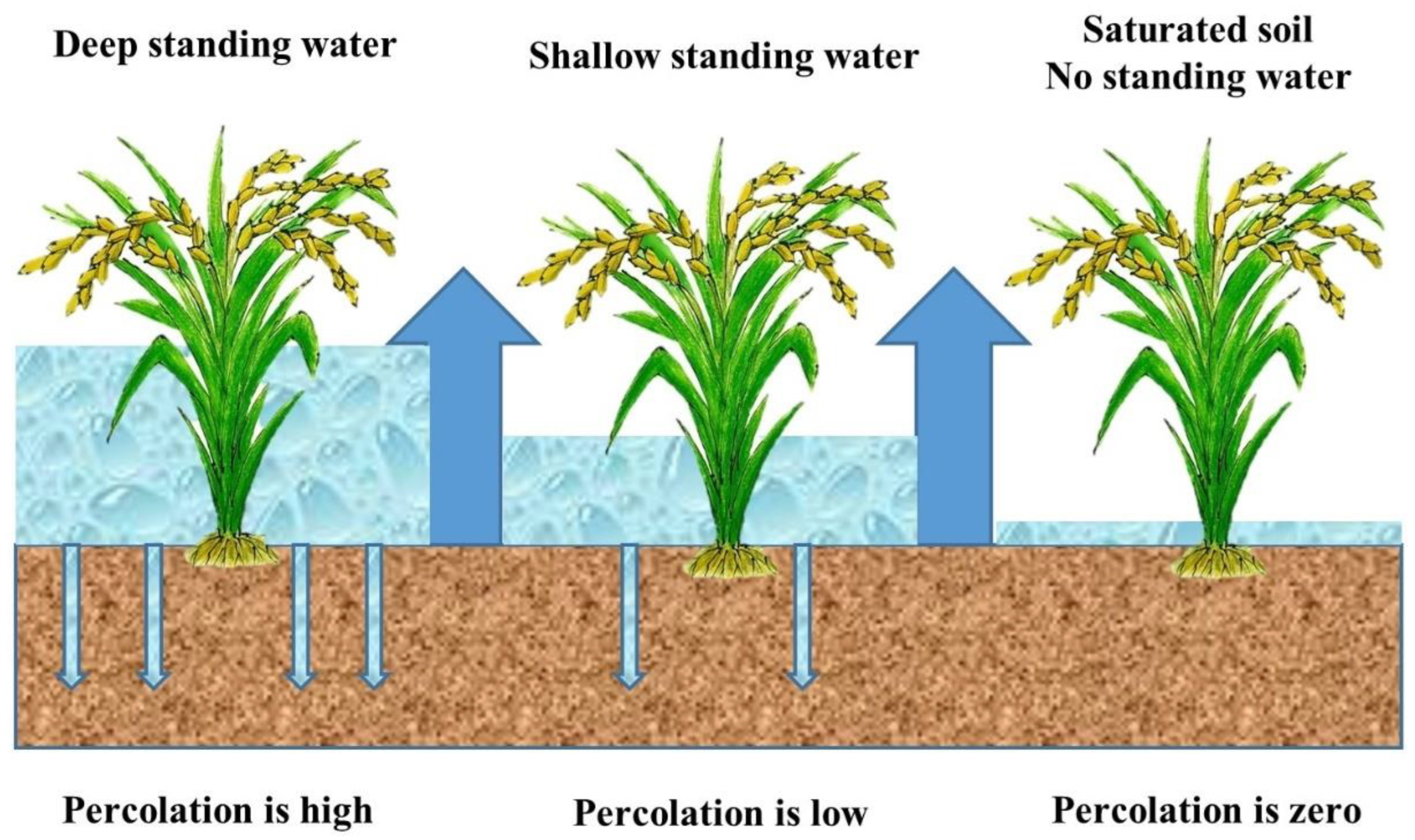
Comparison of traditional and modern rice cultivation systems with their water management approaches
System Selection Tip: When choosing a rice cultivation system, consider your specific conditions: water availability, labor constraints, climate patterns, and environmental priorities. No single system is universally optimal—success comes from matching the system to local conditions and resources.
Advanced Water Management Techniques
Efficient water management is critical for rice production, directly impacting yield, nutrient use efficiency, and environmental sustainability. Modern techniques focus on reducing water consumption while maintaining or improving productivity.
Alternate Wetting and Drying (AWD)
One of the most promising water-saving techniques, AWD involves cycles of flooding followed by allowing the field to dry until hairline cracks appear in the soil:
- Reduces water use by 15-30% compared to continuous flooding
- Decreases methane emissions by 48-93% due to intermittent aerobic conditions
- May increase zinc and iron availability to plants
- Implementation requires monitoring tools like "field water tubes" to track water levels below the soil surface
- Most effective during vegetative and late ripening phases; continuous flooding still recommended during flowering
Saturated Soil Culture (SSC)
This technique maintains the soil at saturation point without standing water:
- Water savings of 25-50% compared to conventional flooding
- Requires precise water control systems and leveled fields
- Reduces percolation and seepage losses
- May increase weed pressure, requiring integrated weed management
- Best suited for areas with reliable irrigation infrastructure
Multiple Inlet Rice Irrigation
A distribution method using plastic pipe or tubing to deliver water simultaneously to different sections of a rice field:
- Improves irrigation uniformity by 21-26%
- Reduces pumping time by 25-50%
- Decreases cold water damage to young plants
- Enables better incorporation of fertilizers across the field
- Initial investment in pipes and fittings offset by water and energy savings
Precision Land Leveling
Using laser or GPS-guided equipment to create a perfectly level field surface:
- Reduces water requirements by 20-30% through uniform distribution
- Improves crop establishment and reduces weed problems
- Increases yield by 5-10% through elimination of high/low spots
- Enhances fertilizer use efficiency
- One-time investment with long-lasting benefits
Implementing Water Management by Growth Stage
Different growth stages of rice require specific water management approaches:
| Growth Stage | Water Management Approach | Benefits |
|---|---|---|
| Land Preparation | Thorough soaking followed by puddling (for lowland rice) | Creates impermeable layer, suppresses weeds, facilitates transplanting |
| Early Vegetative (1-2 weeks after transplanting) | Shallow standing water (2-3 cm) | Promotes root establishment while minimizing water use |
| Mid-Vegetative | Ideal for AWD implementation; allow periodic drying | Encourages deeper root development, saves water |
| Reproductive (Panicle Initiation to Heading) | Continuous shallow flooding (5-7 cm) | Ensures stable conditions during critical yield formation period |
| Ripening | Gradual drying of field 7-10 days before harvest | Facilitates harvesting, improves grain quality |
Critical Period Alert: The period from panicle initiation to flowering (approximately 20 days) is most sensitive to water stress. Maintaining adequate water supply during this phase is essential for preventing significant yield losses, regardless of the water management system used.
Rice Nutrient Requirements by Growth Stage
Rice has specific nutrient needs that change throughout its growth cycle. Understanding these requirements allows for targeted fertilization that maximizes efficiency and yield.
Macronutrient Requirements
The three primary nutrients required in largest quantities are nitrogen (N), phosphorus (P), and potassium (K):
Nitrogen (N)
The most yield-limiting nutrient for rice production:
- Total requirement: 15-20 kg N per ton of grain yield
- Critical during vegetative growth and panicle initiation
- Promotes tillering, leaf development, and grain filling
- Highly susceptible to losses in flooded conditions through denitrification, volatilization, and leaching
- Forms needed by plants: primarily ammonium (NH₄⁺) in flooded conditions rather than nitrate (NO₃⁻)
Phosphorus (P)
Essential for energy transfer and root development:
- Total requirement: 2-4 kg P per ton of grain yield
- Most critical during early growth and reproductive stages
- Enhances root development, tillering, and early flowering
- Availability increases under flooded conditions in acidic soils
- Often applied as basal application before transplanting
Potassium (K)
Increasingly recognized as critical for rice production:
- Total requirement: 15-20 kg K per ton of grain yield
- Important for stem strength, disease resistance, and grain quality
- Enhances nitrogen use efficiency
- Improves water use efficiency and drought tolerance
- Often underestimated in fertilization programs
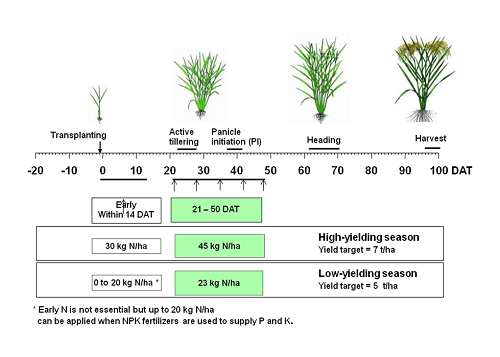
Relative nutrient uptake patterns across different growth stages of rice
Secondary Nutrients and Micronutrients
Several additional nutrients are required in smaller quantities but are nonetheless critical for healthy rice growth:
- Sulfur (S): Required for protein synthesis and enzyme function; deficiency increasingly common in intensive rice systems
- Zinc (Zn): The most commonly deficient micronutrient in rice; critical for enzyme activity and auxin production
- Silicon (Si): Though not essential, significantly benefits rice by improving disease resistance and stem strength
- Iron (Fe): Important for chlorophyll formation; deficiency ("iron chlorosis") common in alkaline soils
- Manganese (Mn): Essential for photosynthesis; deficiency can occur in highly leached soils
Nutrient Uptake by Growth Stage
Rice plants absorb nutrients at different rates depending on their growth stage:
| Growth Stage | Primary Nutrient Demand | Fertilization Focus |
|---|---|---|
| Seedling (0-20 days) | P > N > K | Phosphorus for root development; moderate nitrogen |
| Tillering (20-40 days) | N > K > P | High nitrogen for tiller formation; adequate potassium |
| Panicle Initiation (40-60 days) | N = K > P | Balanced N and K; critical timing for yield formation |
| Flowering (60-80 days) | K > N > P | Potassium for grain filling; reduced nitrogen |
| Ripening (80-100+ days) | K > P > N | Potassium for grain quality; avoid late nitrogen |
Nutrient Monitoring Tip: Leaf color charts (LCCs) are simple yet effective tools for monitoring nitrogen status in rice. Regular checks during the vegetative and early reproductive stages can guide nitrogen application decisions, preventing both deficiency and excess application.
Fertilization Strategies for Optimal Growth
Effective rice fertilization requires more than just applying the right nutrients—timing, placement, and source selection are equally important for maximizing yield while minimizing environmental impact.
Split Application Approach
Rather than applying all fertilizer at once, split application divides nutrients across critical growth stages:
- Basal Application (Pre-planting or at transplanting):
- 100% of phosphorus
- 50-60% of potassium
- 20-30% of nitrogen
- All micronutrients except foliar applications
- Active Tillering Stage (2-3 weeks after transplanting):
- 30-40% of nitrogen
- No additional P or K typically needed
- Panicle Initiation Stage (5-7 weeks after transplanting):
- 30-40% of nitrogen
- Remaining 40-50% of potassium
- Optional Heading Stage Application:
- Small nitrogen dose (5-10% of total) for specific varieties or conditions
- Foliar micronutrient applications if deficiency symptoms appear
Site-Specific Nutrient Management (SSNM)
A precision approach that tailors fertilizer applications to field-specific conditions:
- Uses field history, soil tests, and plant analysis to determine requirements
- Accounts for indigenous soil nutrient supply
- Adjusts rates based on target yields and crop needs
- Improves nitrogen use efficiency by 10-30%
- Can be implemented using simple tools like leaf color charts or sophisticated precision agriculture technology
Nitrogen Management Strategies
As the most dynamic and loss-prone nutrient, nitrogen requires special management:
- Deep Placement Technology: Placing urea supergranules or briquettes 7-10 cm deep in the soil reduces nitrogen losses by 30-40%
- Controlled-Release Formulations: Products with polymer coatings or urease/nitrification inhibitors can improve efficiency by 15-25%
- Ammonium vs. Nitrate Sources: Ammonium forms (urea, ammonium sulfate) are preferred in flooded rice as nitrate is quickly lost through denitrification
- Timing Relative to Water Management: Apply nitrogen to dry soil followed by flooding, or directly into floodwater that will remain for at least 3-5 days
Balancing Organic and Inorganic Sources
Integrating organic and inorganic fertilizers often yields better results than either approach alone:
- Organic Sources:
- Farmyard manure: 5-10 tons/hectare improves soil physical properties and provides slow-release nutrients
- Green manures: Sesbania, Azolla, or blue-green algae can contribute 20-60 kg N/hectare
- Crop residues: Incorporating rice straw returns approximately 40% of N, 30-35% of P, and 80-85% of K taken up by the crop
- Complementary Effects:
- Organic inputs improve soil structure and increase microbial activity
- Inorganic fertilizers provide readily available nutrients during peak demand periods
- Integrated approach can reduce chemical fertilizer needs by 25-30%
Best Practice: Apply organic materials 2-3 weeks before transplanting to allow initial decomposition. This timing minimizes competition for nitrogen between microorganisms and rice plants while reducing methane emissions compared to application at transplanting.
Soil Preparation and Health Management
Soil health forms the foundation of productive and sustainable rice cultivation. Proper preparation and management enhance nutrient availability, water efficiency, and overall system resilience.
Understanding Rice Soils
Rice is unique among major crops in its ability to thrive in waterlogged conditions, but this creates special soil management considerations:
- Puddling: The traditional practice of plowing and harrowing wet soil creates a compacted layer that reduces water percolation
- Redox Conditions: Flooding changes soil chemistry, affecting nutrient availability—iron, manganese, and phosphorus become more available, while nitrogen dynamics shift dramatically
- Soil Structure: Repeated puddling can degrade soil structure over time, potentially affecting crops grown in rotation with rice
- Ideal Properties: Rice performs best in soils with:
- pH range of 5.5-6.5 (slightly acidic)
- Medium to heavy texture (clay or clay loam)
- Moderate to high organic matter (>2%)
- Good water retention capacity
Land Preparation Techniques
Proper land preparation sets the stage for successful rice cultivation:
- Traditional Puddling (Lowland Rice):
- Primary tillage (plowing) to a depth of 15-20 cm
- Flooding the field for 24-48 hours
- Secondary tillage (harrowing) in standing water
- Final leveling for uniform water distribution
- Benefits: weed suppression, reduced percolation, easier transplanting
- Conservation Tillage Approaches:
- Reduced tillage: Limits soil disturbance while maintaining adequate seedbed
- Zero tillage: Direct seeding without soil cultivation, often combined with permanent raised beds
- Benefits: improved soil structure, reduced labor/energy costs, lower greenhouse gas emissions
- Land Leveling:
- Precision leveling using laser or GPS guidance
- Critical for water conservation and uniform crop establishment
- Can increase yields by 5-10% while reducing water use by 20-30%
Managing Soil pH and Salinity
Correcting soil chemical imbalances is essential for nutrient availability:
- Acidic Soils (pH <5.5):
- Apply lime (calcium carbonate) at 1-3 tons/hectare based on soil test
- Incorporate 2-3 months before planting for maximum effectiveness
- Consider tolerant varieties in areas with persistent acidity
- Alkaline Soils (pH >7.5):
- Apply elemental sulfur or gypsum to reduce pH gradually
- Increase frequency of zinc applications as availability decreases in high pH
- Consider acidifying fertilizers like ammonium sulfate
- Saline Soils:
- Leach salts by applying excess irrigation water with adequate drainage
- Incorporate organic matter to improve soil structure
- Consider salt-tolerant varieties in chronically affected areas
- Use raised beds with furrow irrigation to move salts away from root zone
Building Soil Organic Matter
Increasing soil organic matter improves nearly every aspect of soil function:
- Crop Residue Management:
- Incorporate rice straw rather than burning
- Add rice straw compost to improve C:N ratio and accelerate decomposition
- Consider partial incorporation with surface mulching
- Cover Cropping:
- Grow legumes like mung bean or sesbania between rice crops
- Incorporate biomass 2-3 weeks before planting rice
- Potential to contribute 30-60 kg N/hectare while improving soil structure
- Organic Amendments:
- Apply well-decomposed farmyard manure at 5-10 tons/hectare
- Consider biochar application (2-5 tons/hectare) for long-term carbon sequestration
- Use composted agricultural by-products where available
Caution: Fresh organic materials with high C:N ratios (like undecomposed rice straw) can temporarily immobilize nitrogen when incorporated shortly before planting. Either incorporate well in advance (3-4 weeks) or supplement with additional nitrogen fertilizer during the initial decomposition phase.
Sustainable Rice Farming Practices
With rice cultivation facing environmental scrutiny due to its water consumption and greenhouse gas emissions, implementing sustainable practices has become both an ecological necessity and an economic advantage.
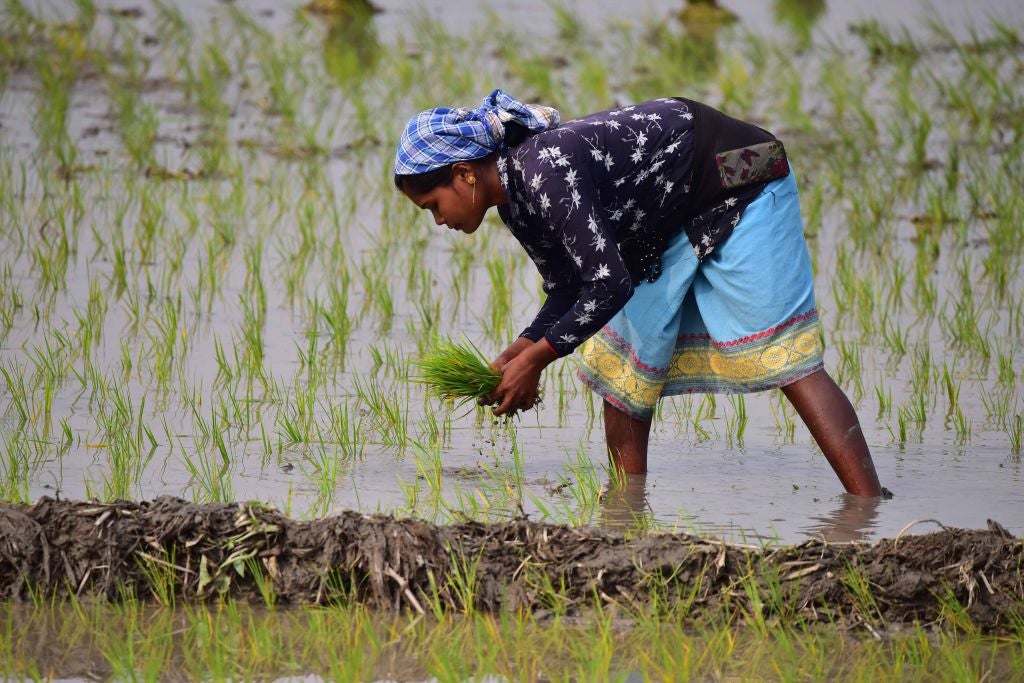
Sustainable rice farming integrating traditional knowledge with modern conservation practices
System of Rice Intensification (SRI)
This integrated approach revolutionizes traditional rice cultivation through several key principles:
- Early transplanting of young seedlings (8-12 days old) at wider spacing (25×25 cm or greater)
- Single seedlings per hill rather than multiple plants
- Intermittent irrigation rather than continuous flooding
- Regular weeding with mechanical weeders that aerate the soil
- Emphasis on organic inputs for soil health
- Benefits include:
- Water savings of 25-50%
- Seed requirement reduced by 80-90%
- Yield increases of 20-50% in many contexts
- Better root development and tiller formation
- Reduced methane emissions due to intermittent irrigation
Integrated Nutrient Management
Combining multiple nutrient sources optimizes efficiency while building long-term soil health:
- Biological Nitrogen Fixation:
- Azolla-Anabaena symbiosis can contribute 25-40 kg N/hectare
- Blue-green algae inoculation adds 10-25 kg N/hectare
- Legume green manures provide 50-100 kg N/hectare
- Organic and Inorganic Integration:
- Base application of organic materials supplemented with targeted mineral fertilizers
- Reduces total chemical fertilizer requirement by 25-35%
- Improves nutrient use efficiency through synergistic effects
- Recycling Nutrients:
- Rice straw incorporation returns approximately 40% of N, 30-35% of P, and 80-85% of K
- Composting agricultural by-products before application
- Using rice husk biochar as a soil amendment
Climate-Smart Rice Production
Techniques that specifically address climate change mitigation and adaptation:
- Methane Reduction Strategies:
- Alternate wetting and drying reduces emissions by 48-93%
- Mid-season drainage breaks continuous methane production
- Proper timing of organic material incorporation
- Carbon Sequestration:
- Conservation tillage to minimize soil carbon loss
- Biochar application for long-term carbon storage
- Cover cropping during fallow periods
- Climate Resilience:
- Drought-tolerant and submergence-tolerant varieties
- Diversified cropping systems to spread climate risk
- Water harvesting and efficient irrigation infrastructure
- Early warning systems for extreme weather events
Integrated Pest Management in Rice
Reducing chemical pesticide dependence through ecological approaches:
- Cultural Controls:
- Synchronized planting within communities to break pest cycles
- Crop rotation to disrupt pest buildup
- Field sanitation and stubble management
- Balanced fertilization to avoid nitrogen-induced susceptibility
- Biological Controls:
- Conservation of natural enemies through reduced pesticide use
- Introduction of predators like ducks in rice-duck systems
- Use of Trichogramma wasps against stem borers
- Microbial controls like Bacillus thuringiensis (Bt)
- Resistant Varieties:
- Deploying varieties with genetic resistance to major pests and diseases
- Variety rotation to prevent resistance breakdown
Sustainable Implementation Tip: Rather than attempting to implement all sustainable practices at once, start with those addressing your most pressing challenges (water scarcity, high fertilizer costs, pest pressure). Once successful, gradually incorporate additional practices into your system. This step-by-step approach reduces risk while building toward fully sustainable production.
Technology and Precision Agriculture in Rice
Modern technology is transforming rice cultivation, enabling more precise management of water, nutrients, and other inputs while providing data-driven insights for decision-making.
Remote Sensing and Monitoring
Advanced imaging technologies provide unprecedented visibility into crop conditions:
- Satellite Imaging:
- Normalized Difference Vegetation Index (NDVI) for monitoring plant vigor
- Detection of stress patterns across large areas
- Yield forecasting and production estimates
- Now available through affordable subscription services or free platforms like NASA's LandViewer
- Drone Technology:
- High-resolution multispectral imaging for early stress detection
- Thermal imaging to identify water stress or drainage issues
- Targeted application of inputs in problem areas
- Rapid field assessment without crop damage from foot traffic
- In-Field Sensors:
- Soil moisture monitors to optimize irrigation scheduling
- Automated water level sensors for precise AWD implementation
- Weather stations for microclimate data
- Integration with smartphone apps for real-time alerts
Variable Rate Technology (VRT)
Systems that adjust input application rates based on specific field conditions:
- Site-Specific Fertilization:
- Application maps created from soil tests, yield data, and crop sensors
- Equipment that automatically adjusts rates as it moves through the field
- Potential fertilizer savings of 10-30% with yield improvements
- Particularly effective for addressing in-field variability
- Precision Water Management:
- Automated irrigation systems with variable flow capabilities
- Zoned irrigation based on soil type and topography
- Integration with soil moisture sensors for demand-based irrigation
- Targeted Crop Protection:
- Spot spraying systems that detect and treat only affected areas
- Potential chemical reduction of 50-80% compared to broadcast application
- Reduced environmental impact and lower input costs
Decision Support Systems
Software and applications that help farmers make data-driven management decisions:
- Crop Modeling Tools:
- Simulation of different management scenarios before implementation
- Yield forecasting based on weather, soil, and management inputs
- Optimization of planting dates and variety selection
- Examples include ORYZA, DSSAT, and AquaCrop models
- Mobile Applications:
- Rice Crop Manager (IRRI): Provides field-specific management recommendations
- Nutrient Manager for Rice: Calculates optimal fertilizer rates and timing
- Plantix: Uses AI to diagnose pest and disease problems from photos
- RiceAdvice: Tailors agronomic advice to local conditions
- Integrated Management Platforms:
- Comprehensive farm management systems that combine multiple data sources
- Cloud-based platforms accessible from computers and mobile devices
- Historical data storage for long-term analysis and improvement
- Often include weather forecasting for proactive management
Accessible Technology for Smallholders
Low-cost solutions that make precision farming accessible to small-scale producers:
- Simple Monitoring Tools:
- Leaf color charts for nitrogen management
- PVC pipe "pani pipe" water level indicators for AWD implementation
- Simple soil test kits for basic analysis
- Community-Based Technology Sharing:
- Cooperative ownership of drones or sensors
- Mobile soil testing services
- Group access to satellite imagery and interpretation
- Digital Extension Services:
- SMS-based advisory systems
- Voice message services for areas with limited literacy
- Video-based training distributed via smartphones
- Community digital hubs for accessing online resources
Technology Adoption Strategy: Focus first on technologies that address your most significant yield-limiting factors or resource inefficiencies. Even simple technological interventions like leaf color charts for nitrogen management or basic soil moisture monitoring can provide substantial returns before investing in more complex systems.
Common Challenges and Solutions
Rice farmers face numerous challenges in water management and fertilization. Understanding these obstacles and implementing targeted solutions is key to successful production.
Water Management Challenges
Addressing water-related issues requires both technical and management approaches:
| Challenge | Causes | Solutions |
|---|---|---|
| Inconsistent Water Supply | Unreliable irrigation infrastructure; climate variability; competing water demands | Water harvesting systems; AWD to extend limited supplies; field-level water storage; community water scheduling |
| Excessive Water Use | Continuous flooding practices; poorly leveled fields; high percolation rates in sandy soils | Precision land leveling; AWD implementation; improved bunding; soil amendments to reduce percolation |
| Poor Drainage | Heavy clay soils; low-lying topography; inadequate drainage infrastructure | Raised bed systems; field channels; subsurface drainage; water-tolerant varieties |
| Salinity Intrusion | Coastal locations; over-extraction of groundwater; poor irrigation water quality | Salt-tolerant varieties; leaching practices; gypsum application; raised beds with furrow irrigation |
| Managing AWD Implementation | Uncertainty about safe drying thresholds; fear of yield loss; labor constraints | Simple water tubes for monitoring; farmer field schools; community-level coordination; gradual transition with safe AWD first |
Nutrient Management Challenges
Overcoming fertilization obstacles requires adaptive management and proper timing:
| Challenge | Causes | Solutions |
|---|---|---|
| Low Nitrogen Use Efficiency | Volatilization; denitrification; leaching in flooded conditions; poor timing | Deep placement technology; split applications; controlled-release formulations; match application to peak demand periods |
| Phosphorus Fixation | Binding with iron, aluminum, or calcium in soil; unavailability in acidic or alkaline conditions | Band application near roots; mycorrhizal inoculation; organic matter addition; maintenance of optimal pH range |
| Micronutrient Deficiencies | High pH soils; intensive cropping without replenishment; antagonistic interactions | Regular soil testing; foliar applications; micronutrient-enriched fertilizers; balanced nutrition programs |
| Fertilizer Cost and Availability | Market fluctuations; supply chain disruptions; subsidy reductions | Enhanced efficiency fertilizers; biological nitrogen fixation; recycling of organic residues; precise application to maximize returns |
| Imbalanced Fertilization | Focus on nitrogen alone; inadequate soil testing; traditional practices | Regular soil analysis; balanced NPK application; crop nutrient removal calculations; attention to secondary and micronutrients |
Soil-Related Challenges
Addressing soil constraints is fundamental to water and nutrient management success:
- Soil Compaction:
- Caused by repeated puddling, heavy machinery, and continuous flooding
- Solutions include periodic deep tillage, incorporation of organic matter, and crop rotation with deep-rooted species
- Low Organic Matter:
- Results from residue removal or burning, minimal organic inputs, and rapid decomposition in tropical conditions
- Address through crop residue incorporation, green manuring, compost application, and reduced tillage
- Acidification:
- Accelerated by continuous use of ammonium-based fertilizers and intensive cropping
- Manage with regular lime application, reduced ammonium fertilizer rates, and use of less acidifying nitrogen sources
- Iron Toxicity:
- Common in highly reduced (waterlogged) acidic soils
- Mitigate through water management (periodic drainage), potassium application, tolerant varieties, and foliar zinc application
Practical Implementation Issues
Addressing the human and practical aspects of adopting improved techniques:
- Knowledge Barriers:
- Demonstration plots showing side-by-side comparison of traditional vs. improved practices
- Farmer field schools with hands-on learning
- Leveraging early adopters as community ambassadors
- Labor Constraints:
- Mechanization options for small and large farms
- Labor-saving technologies like direct seeding and mechanical weeders
- Community labor sharing during peak demand periods
- Risk Perception:
- Incremental adoption allowing farmers to test practices on portions of their land
- Risk-sharing mechanisms through insurance or community guarantees
- Robust monitoring to quickly address emerging issues
- Access to Inputs and Equipment:
- Cooperative ownership or rental of specialized equipment
- Local production of tools like water tubes for AWD
- Community-based service providers for specialized operations
Adaptation Reminder: While this guide presents best practices, all recommendations must be adapted to local conditions. Soil type, climate, water availability, local crop varieties, and socioeconomic factors will influence the optimal approach for your specific context. Start with small-scale trials before widespread implementation of new techniques.
Regional Case Studies and Success Stories
Examining successful real-world implementations provides valuable insights and inspiration for improving rice cultivation practices.
Asia: System of Rice Intensification in Vietnam
Vietnam's Mekong Delta region has seen remarkable success with SRI implementation:
- Key Interventions:
- Young seedling transplanting (8-12 days) at wider spacing (25×25 cm)
- AWD water management with simple water tubes
- Integrated nutrient management combining organic and inorganic sources
- Mechanical weeders for soil aeration and weed control
- Results:
- Yield increases of 9-15% compared to conventional practices
- Water savings of 33% (from 3,000 m³/ha to 2,000 m³/ha)
- Seed requirement reduced by 70-80%
- Chemical fertilizer use reduced by 25-35%
- Greenhouse gas emissions decreased by approximately 30%
- Implementation Approach:
- Initial farmer field schools with demonstration plots
- Progressive scaling through farmer-to-farmer training
- Local adaptation of SRI principles rather than rigid formula
- Integration with local indigenous knowledge
North America: Alternate Wetting and Drying in Arkansas, USA
Arkansas, which produces nearly 50% of U.S. rice, has pioneered AWD adoption:
- Key Interventions:
- Multiple-inlet irrigation to improve distribution uniformity
- Computer-controlled irrigation scheduling with soil moisture sensors
- Precision land leveling using GPS-guided equipment
- Tailored AWD protocols for mechanized, large-scale production
- Results:
- Water use reduced by 30% (from ~900 mm to ~630 mm per season)
- Pumping costs reduced by $32-65 per hectare
- No significant yield penalties when properly implemented
- Methane emissions reduced by approximately 50%
- Groundwater depletion rates slowed in critical aquifer areas
- Implementation Approach:
- University-farmer partnerships for technology development
- Economic incentives through USDA conservation programs
- Integration with existing precision agriculture systems
- Strong extension support and technical assistance
Africa: Integrated Soil Fertility Management in Madagascar
Madagascar's highland rice systems demonstrate effective integration of traditional and modern approaches:
- Key Interventions:
- Compost application (5-7 tons/ha) from mixed farm residues
- Green manure rotation with Vicia villosa (hairy vetch)
- Small, targeted doses of mineral fertilizer (especially phosphorus)
- Rice-vegetable rotations to maximize nutrient cycling
- Results:
- Yield increases from 2.5 tons/ha to 4-5 tons/ha
- Chemical fertilizer use reduced by 50-60%
- Improved soil organic matter content from 2% to 3.5% over 5 years
- Greater system resilience during drought periods
- Additional income from rotation crops
- Implementation Approach:
- Participatory technology development with farmers
- Step-wise adoption allowing gradual risk management
- Community seed banks for green manure crops
- Integration with local farming traditions
Latin America: Resource-Conserving Technologies in Brazil
Brazil's southern rice-growing regions have pioneered conservation approaches:
- Key Interventions:
- Zero-tillage direct seeding with specialized equipment
- Raised bed systems with precise irrigation control
- Site-specific nutrient management using yield mapping
- Integration of rice with livestock through winter pastures
- Results:
- Soil erosion reduced by 70-90%
- Fuel consumption decreased by 60-70%
- Labor requirements reduced by 30%
- Water productivity improved by 35-45%
- System profitability increased through diversification
- Implementation Approach:
- Strong producer organizations driving innovation
- Public-private partnerships for technology development
- Whole-farm system approach rather than single-practice focus
- Mechanization adapted to both large and medium-scale farms
Implementation Lessons: These case studies reveal several common success factors: (1) Adapting general principles to local conditions rather than applying rigid formulas, (2) Using a step-wise adoption approach that manages risk, (3) Combining traditional knowledge with scientific innovations, and (4) Building strong farmer-to-farmer networks for knowledge sharing. Consider how these elements might apply to your context when implementing new practices.
Conclusion: Future of Rice Cultivation
Rice cultivation stands at a crossroads. The pressures of climate change, water scarcity, and environmental concerns demand transformation, while the imperative to feed a growing population remains. The future of rice production will be shaped by our ability to balance productivity with sustainability through intelligent water and nutrient management.
Embracing an Integrated Approach
The most successful rice cultivation systems of the future will likely blend multiple strategies tailored to local conditions:
- Water-saving techniques like AWD combined with precise nutrient management
- Integration of traditional wisdom with modern scientific insights
- Appropriate technology adoption across farm scales—from simple tools for smallholders to sophisticated precision systems for larger operations
- Resilient varieties combined with improved management practices
- Landscape-level approaches that consider watershed management and ecosystem services
Emerging Innovations on the Horizon
Several promising developments may further transform rice cultivation:
- Climate-Resilient Varieties: Development of rice varieties that maintain productivity under heat stress, flooding, salinity, and drought conditions while requiring fewer inputs
- Digital Agriculture: Expanded access to remote sensing, AI-driven recommendations, and predictive analytics tailored for rice systems
- Circular Economy Approaches: Converting rice byproducts into value-added products, from biochar to packaging materials
- Enhanced Biological Systems: Engineered microbial communities that enhance nutrient availability and plant resilience
- Carbon Markets: Financial incentives for climate-smart practices through carbon credits and ecosystem service payments
Path Forward for Producers
For rice farmers seeking to improve their water and nutrient management, consider this practical path forward:
- Assess Your Current System: Identify specific limitations in your production system—water constraints, nutrient inefficiencies, soil health issues, or other yield-limiting factors
- Start Small: Begin with pilot implementations of new practices on a portion of your land to gain confidence and adapt techniques to your conditions
- Measure Results: Establish simple but consistent monitoring of key metrics—water use, input costs, labor requirements, and yield—to quantify improvements
- Connect with Others: Join or form learning groups with other farmers to share experiences and collectively solve challenges
- Progressive Implementation: Gradually expand successful practices while continuing to adapt and refine them for your specific context
By mastering the interconnected practices of water management and fertilization in rice cultivation, producers can achieve the seemingly contradictory goals of increasing productivity while reducing environmental impact. The techniques outlined in this guide provide a roadmap toward rice production systems that are not only high-yielding but also resilient, resource-efficient, and sustainable for generations to come.
The journey toward improved rice cultivation is continuous—each season bringing new challenges and opportunities for learning. By embracing this process of adaptive management, rice farmers can thrive amid changing conditions while contributing to global food security and environmental stewardship.